NEUROPHARMACOLOGY & NOCTURNAL ENDOCRINOLOGY
Chamomile & Ceylon Cinnamon Infusion: Apigenin GABA-A Agonism & Nocturnal Glycemic Stabilization
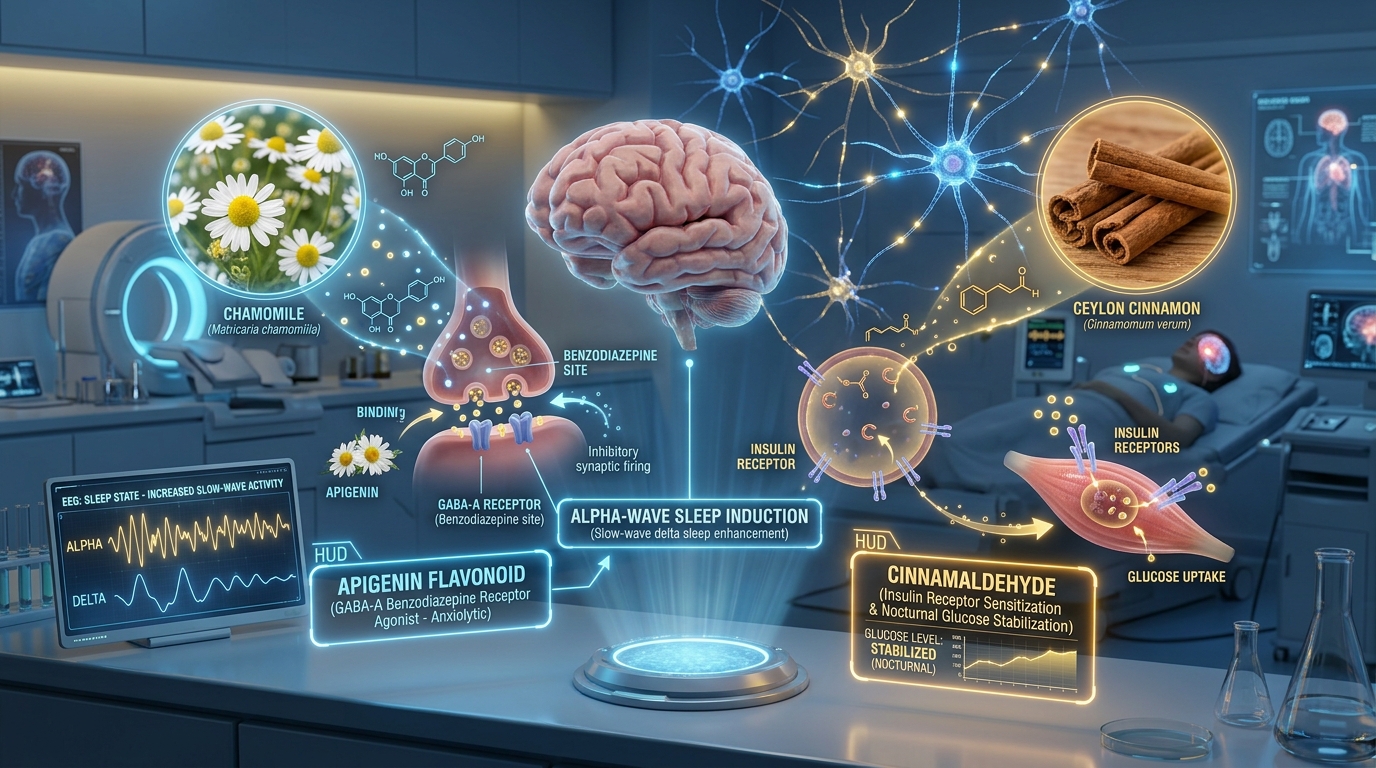
3D neuroscience and metabolic simulation: how Apigenin crosses the blood-brain barrier to modulate GABA-A benzodiazepine sites, while Cinnamaldehyde preserves nocturnal euglycemia against cortisol spikes.
Science Verdict Meter
Remedy Reliability Score
Scientific Verdict
Robust neuropharmacological validation for GABA-mediated sedation and insulin receptor sensitization across clinical sleep trials
Primary Benefit
Abates presleep cognitive rumination, deepens slow-wave delta sleep, and halts nocturnal cortisol awakenings
Safety Level
Low Risk (Safe)
Flavonoid Apigenin in chamomile acts as a selective partial agonist at GABA-A benzodiazepine sites, quietening cerebral hyperexcitability, while Ceylon cinnamon’s Cinnamaldehyde stabilizes nocturnal glucose to eliminate sudden 3:00 AM awakenings from reactive hypoglycemia.
1. Standard Ingredients
- Whole dried German Chamomile flowers (Matricaria chamomilla)1 tbsp (~2g)
- True Ceylon cinnamon quill (broken into pieces)1 small stick (~2g)
- Boiling purified water250ml (90 - 95°C)
2. Preparation Steps
- 1Place chamomile blossoms and crushed Ceylon cinnamon into a porcelain teapot or heatproof mug.
- 2Pour 250ml near-boiling water over the botanicals; cover tightly with a lid for 10 minutes to condense volatile chamazulene vapors.
- 3Strain into a cup; drink while soothingly warm.
- ✕Avoid heavy daily use of common Cassia cinnamon due to high hepatotoxic coumarin concentrations; always select true Ceylon.
- ✕Individuals with verified severe Asteraceae ragweed pollen allergies should perform tolerance testing first.
- ✕Do not co-ingest with prescription Benzodiazepine sedatives to avoid excessive CNS depression.
Check Your Suitability
Answer 3 quick questions (15 seconds) to confirm whether this nocturnal tea is safe and suitable for you.
#1.
#2.
#3.
1. Neuropharmacology: Apigenin Allosteric Modulation of GABA-A Receptors
German Chamomile (Matricaria chamomilla) is uniquely enriched in the natural bioflavonoid Apigenin, present in free and glucoside states.
Radioligand binding investigations confirm that Apigenin crosses the blood-brain barrier to selectively occupy benzodiazepine binding sites on the $gamma$-aminobutyric acid type A ($GABA_A$) chloride ionophore complex.
Unlike synthetic sedative hypnotics that provoke severe receptor desensitization and dependence, Apigenin functions as a partial agonist. It gently amplifies inhibitory post-synaptic chloride ion influx, dampening limbico-cortical hyperarousal and coaxing the brain into restorative Delta slow-wave oscillations.
2. Metabolic Synchronization: Cinnamaldehyde Blunting of Nocturnal Cortisol Surges
A prevalent yet misdiagnosed cause of mid-sleep arousal in high-stress populations is nocturnal glycemic volatility.
Cinnamaldehyde and polymeric proanthocyanidin oligomers from Ceylon cinnamon function as natural insulin mimetics, stimulating the autophosphorylation of insulin receptor tyrosine kinases within somatic tissues.
By flattening nocturnal glucose fluctuations into an uninterrupted, stable baseline curve, the body avoids precipitous glucose valleys that stimulate emergency sympathoadrenal Cortisol cascades, safeguarding unbroken sleep cycles.
- Shortens Sleep Onset Latency and elevates cumulative Sleep Efficiency metrics.
- Preserves NREM stages 3 and 4 slow-wave sleep duration for glymphatic brain detoxification.
- Improves next-morning fasting glucose sensitivity and cognitive clarity.
Check Your Suitability
Answer 3 quick questions (15 seconds) to confirm whether this nocturnal tea is safe and suitable for you.
#1.
#2.
#3.
Myth vs. Science: Social Media Fact-Check
Herbal chamomile tea functions as an instantaneous 100% cure for severe clinical insomnia from day one.
Herbal tisanes gently modulate physiological circadian architecture without the disruptive hypnotic amnesia of prescription sedatives; best coupled with sleep hygiene.
All grocery store cinnamon barks are identical in safety and bioactivity.
Cheap Cassia cinnamon contains up to 1000 times higher Coumarin levels than true Ceylon cinnamon; chronic daily Cassia intake risks cumulative hepatic stress.
Frequently Asked Questions
Sources
Molecular Medicine Reports: Chamomile bioactives and GABA neurochemistry ↗Diabetes Care: Cinnamon Improves Glucose in Clinical Trials ↗Sleep Medicine Reviews: Herbal therapeutics for insomnia systematic review ↗Explore More Molecular Analyses & Remedy Checks
Cellular mechanics, phytochemical evaluations, and clinical safety screenings.

Coffee & Spice Infusions: A Scientific Companion to Targeted Wellness
Integrating specific spices into your coffee can leverage their bioactive compounds for enhanced physiological benefits, from blood sugar regulation to cognitive support and digestive comfort.

Gut Microbiome Modulation: The Synergistic Actions of Pectin, Fiber, and Actinidin from Apple, Chia, and Kiwi
This fiber-rich smoothie promotes healthy digestion and gut motility, but does not offer a 'colon flush' or cure chronic inflammation.

Homemade Coconut Oil: Unpacking the Phytochemistry of Medium-Chain Triglycerides
Homemade coconut oil provides a rich source of MCTs, particularly lauric acid, offering unique metabolic and antimicrobial properties, but requires mindful consumption due to its caloric density.

Synergistic Health Benefits of Spiced Coffee: A Biomedical Perspective
Incorporating specific spices into coffee can leverage their bioactive compounds to support blood sugar control, cognitive function, stress reduction, and metabolic health.
Homemade Cough Syrup: Unpacking the Science of Onion, Garlic, Lemon, and Honey
Onion, garlic, lemon, and honey offer a synergistic blend of compounds with potential benefits for soothing coughs and throat irritation.

Ginger, Calamansi, and Honey: Unpacking the Science of a Natural Wellness Elixir
This traditional blend offers synergistic anti-inflammatory, immune-supportive, and antimicrobial benefits, particularly for mild respiratory symptoms.

Turmeric: A Scientific Companion to Its Anti-inflammatory and Antioxidant Potentials
Turmeric, particularly its curcuminoids, offers potent anti-inflammatory and antioxidant benefits, with piperine significantly enhancing its systemic bioavailability.

Matcha: The Synergistic Science of Sustained Focus and Cognitive Enhancement
Matcha's unique combination of L-theanine and caffeine promotes calm, sustained focus by modulating brain waves and neurotransmitter activity.

Ginger's Therapeutic Potential: A Biomedical Review of Digestion, Inflammation, and Cellular Defense
Daily ginger intake can significantly support digestive comfort, mitigate nausea, and contribute to a healthy inflammatory and antioxidant status through its potent bioactive compounds.

Water-Cooked Chicken: The Science of Reducing AGEs and Preserving Protein Integrity
Cooking chicken in water instead of deep-frying drastically lowers calorie density and harmful glycation compounds.