PHARMACOLOGICAL DISSECTION & NEPHROLOGY
Watermelon & Seed Elixir: The L-Citrulline Mechanism for Urinary Alkalization and Renal Flushing
Biochemical anatomical dissection of watermelon: exploring how L-Citrulline, Lycopene, and Cucurbocitrin alkalize urinary pH, stimulate glomerular filtration, and flush micro-calculi.
Science Verdict Meter
Remedy Reliability Score
Scientific Verdict
Robust scientific evidence for renal microcirculation support and urinary alkalization
Primary Benefit
Enhances physiological diuresis, flushes urinary sediment, and reduces uric acid crystallization
Safety Level
Low Risk (Safe)
L-Citrulline concentrated in watermelon rind powers the urea cycle for ammonia clearance, while organic potassium alkalizes urine above pH 6.5 to dissolve uric acid crystals. Caution: Stage 3-5 kidney disease patients must restrict intake due to hyperkalemia risk.
1. Standard Ingredients
- Fresh watermelon with white rind300g
- Fresh black watermelon seeds1 tbsp (10g)
- Fresh lime juice1/2 lime
- Purified water100ml
2. Preparation Steps
- 1Thoroughly wash the outer rind; slice away the thin green skin while keeping all white rind and black seeds intact.
- 2Place the flesh, rind, seeds, and 100ml water into a high-speed blender; blend for 60 seconds until completely smooth.
- 3Stir in fresh lime juice and consume immediately without straining to maximize dietary fiber and trace mineral absorption.
- ✕Do not add refined sugars or condensed milk (fructose spikes serum uric acid levels).
- ✕Avoid consuming within 2 hours of bedtime to prevent nocturia and sleep fragmentation.
- ✕Patients with stage 3+ chronic kidney disease or dialysis MUST AVOID due to dangerous potassium accumulation risk.
Check Your Suitability
Answer 3 quick questions (15 seconds) to determine if this watermelon renal remedy is safe for you.
#1.
#2.
#3.
1. Anatomical Profile & Bioactive Compounds of Citrullus lanatus
From a phytochemical perspective, watermelon is not merely 92% water; it is a structured biological colloid enriched with electrolytes and cytoprotective molecules.
The White Rind: Hosts the highest concentration of L-Citrulline. This non-protein amino acid serves as an indispensable fuel for the hepatic urea cycle, neutralizing neurotoxic ammonia into excretable urea.
The Red Pulp: Abundant in bioavailable Lycopene (40% higher than ripe tomatoes), providing critical scavenging of reactive oxygen species (ROS) in renal interstitial tissues.
The Black Seeds: Contain Cucurbocitrin, a unique glucoside demonstrated to support glomerular filtration rate (GFR) and capillary permeability.
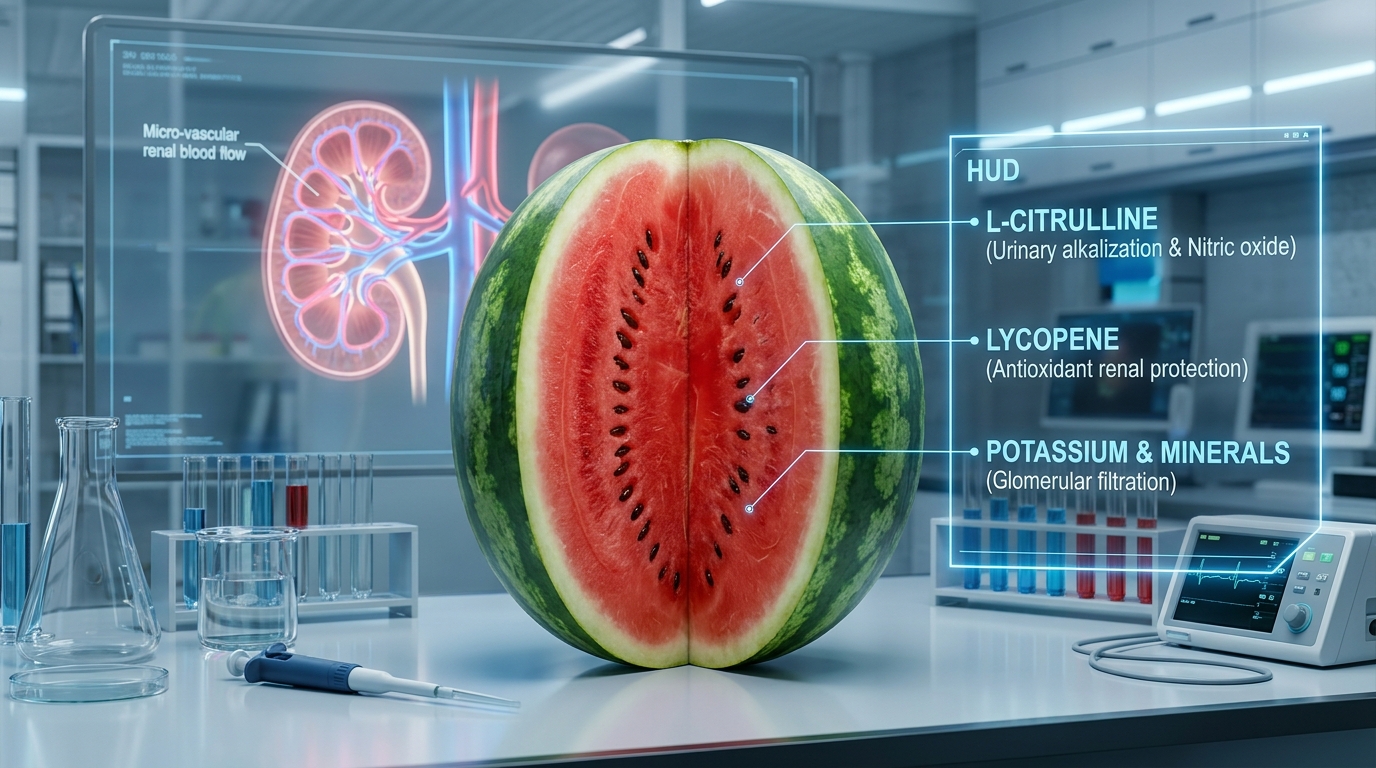
2. Molecular Mechanism: Urinary Alkalization and Glomerular Hemodynamics
Uric acid nephrolithiasis develops primarily when urinary pH plummets below 5.5, creating a supersaturated environment where free uric acid precipitates into micro-crystalline lattices.
The combination of watermelon and fresh lime delivers organic potassium and citrate anions. Metabolism yields endogenous bicarbonate ions, buffering urinary pH into the optimal 6.5 – 7.0 corridor. In this range, uric acid solubility multiplies up to tenfold, preventing crystallization and facilitating spontaneous clearance of gravel.
Simultaneously, renal conversion of L-Citrulline to L-Arginine activates endothelial nitric oxide synthase (eNOS), dilating renal microvasculature and augmenting capillary perfusion without increasing central blood pressure.
- Expands physiological urine output to mechanically flush renal calyces.
- Citrate chelates ionic calcium, suppressing calcium oxalate crystal nucleation.
- Lycopene preserves proximal tubular epithelial integrity against oxidative injury.
Check Your Suitability
Answer 3 quick questions (15 seconds) to determine if this watermelon renal remedy is safe for you.
#1.
#2.
#3.
Myth vs. Science: Social Media Fact-Check
Drinking watermelon juice dissolves large 15mm kidney stones within 3 days.
Watermelon juice only assists in flushing gravel and micro-stones under 4mm by expanding urine volume and elevating pH. Large calculi require urological intervention.
Swallowing watermelon seeds causes appendicitis or intestinal blockages.
Milled watermelon seeds deliver bioavailable plant protein, zinc, and essential fatty acids, carrying zero association with appendicitis.
Frequently Asked Questions
Sources
USDA Agricultural Research Service - Watermelon Citrulline Studies ↗PubMed: Oral L-citrulline supplementation and renal hemodynamics ↗Journal of Urology: Citrate and Urinary Alkalinization Protocols ↗Explore More Molecular Analyses & Remedy Checks
Cellular mechanics, phytochemical evaluations, and clinical safety screenings.

Coffee & Spice Infusions: A Scientific Companion to Targeted Wellness
Integrating specific spices into your coffee can leverage their bioactive compounds for enhanced physiological benefits, from blood sugar regulation to cognitive support and digestive comfort.

Gut Microbiome Modulation: The Synergistic Actions of Pectin, Fiber, and Actinidin from Apple, Chia, and Kiwi
This fiber-rich smoothie promotes healthy digestion and gut motility, but does not offer a 'colon flush' or cure chronic inflammation.

Homemade Coconut Oil: Unpacking the Phytochemistry of Medium-Chain Triglycerides
Homemade coconut oil provides a rich source of MCTs, particularly lauric acid, offering unique metabolic and antimicrobial properties, but requires mindful consumption due to its caloric density.

Synergistic Health Benefits of Spiced Coffee: A Biomedical Perspective
Incorporating specific spices into coffee can leverage their bioactive compounds to support blood sugar control, cognitive function, stress reduction, and metabolic health.
Homemade Cough Syrup: Unpacking the Science of Onion, Garlic, Lemon, and Honey
Onion, garlic, lemon, and honey offer a synergistic blend of compounds with potential benefits for soothing coughs and throat irritation.

Ginger, Calamansi, and Honey: Unpacking the Science of a Natural Wellness Elixir
This traditional blend offers synergistic anti-inflammatory, immune-supportive, and antimicrobial benefits, particularly for mild respiratory symptoms.

Turmeric: A Scientific Companion to Its Anti-inflammatory and Antioxidant Potentials
Turmeric, particularly its curcuminoids, offers potent anti-inflammatory and antioxidant benefits, with piperine significantly enhancing its systemic bioavailability.

Matcha: The Synergistic Science of Sustained Focus and Cognitive Enhancement
Matcha's unique combination of L-theanine and caffeine promotes calm, sustained focus by modulating brain waves and neurotransmitter activity.

Ginger's Therapeutic Potential: A Biomedical Review of Digestion, Inflammation, and Cellular Defense
Daily ginger intake can significantly support digestive comfort, mitigate nausea, and contribute to a healthy inflammatory and antioxidant status through its potent bioactive compounds.

Water-Cooked Chicken: The Science of Reducing AGEs and Preserving Protein Integrity
Cooking chicken in water instead of deep-frying drastically lowers calorie density and harmful glycation compounds.